
IN THE HIGH COURT OF MALAYA AT KUALA LUMPUR (COMMERCIAL DIVISION)
ORIGINATING SUMMONS NO: WA-24NCC-44-02/2021
In the matter of PNL Business Services Sdn Bhd (Company No. 576235-M)
And
In the matter of s. 346 of the Companies Act, 2016
And
In the matter Order 88 of the Rules of Court 2012
And
In the matter of a partnership And
In the matter of the Partnership Act 1961
BETWEEN
LOH TECK WAH
(NRIC No.: 731106-14-5267) … PLAINTIFF
AND
1. LIM PANG KIAM
(NRIC No.: 631208-01-5529)
2. YAP CHEE KHENG
(NRIC No.: 730526-14-5285)
3. LEE SAN KOON (f)
(NRIC No.: 710318-10-5432)
4. SIEW SUET WEI (f)
(NRIC No.: 681119-10-5528)
5. PNL BUSINESS SERVICES SDN BHD
(Company No.: 5676235-M) … DEFENDANTS
HEARD TOGETHER WITH
IN THE HIGH COURT OF MALAYA AT KUALA LUMPUR (COMMERCIAL DIVISION)
ORIGINATING SUMMONS NO: WA-24NCC-59-02/2021
In the matter of Tian An Trading Sdn Bhd (Company No. 848748- P) And
In the matter of s.346 of the Companies Act 2016
And
In the matter of Order 88 of the Rules of Court 2012
And
In the matter of a partnership dispute under Originating Summons No. WA-24NCC-44- 02/2021
BETWEEN
LOH TECK WAH
(NRIC NO.: 731106-14-5267) … PLAINTIFF
AND
1. LIM PANG KIAM
(NRIC NO.: 631208-01-5529)
2. YAP CHEE KHENG
(NRIC NO.: 730526-14-5285)
3. TIAN AN TRADING SDN BHD
(Company No.: 848748-P) ... DEFENDANTS
HEARD TOGETHER WITH
IN THE HIGH COURT OF MALAYA AT KUALA LUMPUR (COMMERCIAL DIVISION)
ORIGINATING SUMMONS NO. WA-24NCC-91-02/2021
In the matter of Warna Kencana Sdn Bhd (Company No. 1154409- P)
And
In the matter of s.346 of the Companies Act 2016
And
In the matter of Order 88 of the Rules of Court 2012
And
In the matter of a partnership dispute under Originating Summons No. WA-24NCC-44- 02/2021
BETWEEN
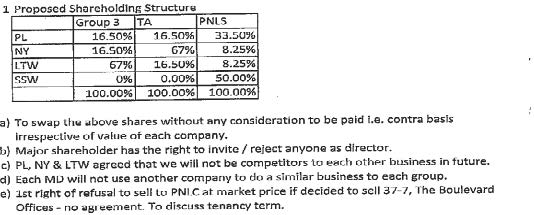
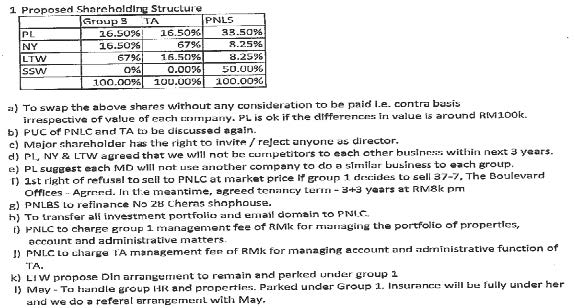
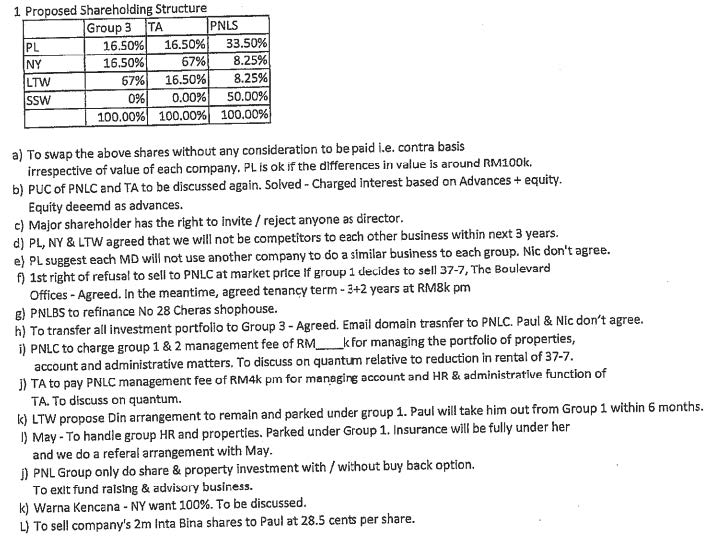
LOH TECK WAH
(NRIC NO.: 731106-14-5267) ... PLAINTIFF AND
1. LIM PANG KIAM
(NRIC NO.: 631208-01-5529)
2. YAP CHEE KHENG
(NRIC NO.: 730526-14-5285)
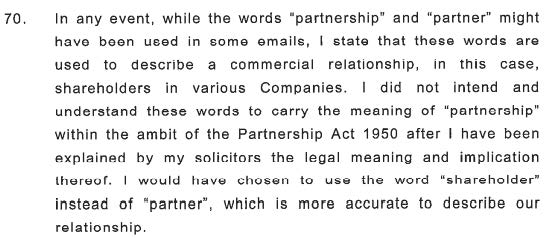
3. WARNA KENCANA SDN BHD ... DEFENDANTS
(Company No.: 1154409-P)
HEARD TOGETHER WITH
IN THE HIGH COURT OF MALAYA AT KUALA LUMPUR (COMMERCIAL DIVISION)
ORIGINATING SUMMONS NO. WA-24NCC-104-03/2021
In the matter of Urban Fiesta Sdn Bhd (Company No. 1163361-W)
And
In the matter of s.346 of the Companies Act 2016
And
In the matter of Order 88 of the Rules of Court 2012
And
In the matter of a partnership dispute under Originating
Summons No. WA-24NCC-44- 02/2021
BETWEEN
LOH TECK WAH
(NRIC NO.: 731106-14-5267) ... PLAINTIFF AND
1. LIM PANG KIAM
(NRIC NO.: 631208-01-5529)
2. YAP CHEE KHENG
(NRIC NO.: 730526-14-5285)
3. URBAN FIESTA SDN BHD
(Company No.: 1163361-W) … DEFENDANTS
HEARD TOGETHER WITH
IN THE HIGH COURT OF MALAYA AT KUALA LUMPUR (COMMERCIAL DIVISION)
ORIGINATING SUMMONS NO. WA-24NCC-119-03/2021
In the matter of PNL Trading Sdn Bhd (Company No. 651286- P)
And
In the matter of Subang Industry Park Sdn Bhd (Company No. 826658-W)
And
In the matter of s.346 of the Companies Act 2016
And
In the matter of Order 88 of the Rules of Court 2012
And
In the matter of a partnership dispute under Originating Summons No. WA-24NCC-44- 02/2021
BETWEEN
LOH TECK WAH
(NRIC NO.: 731106-14-5267) … PLAINTIFF AND
1. LIM PANG KIAM
(NRIC NO.: 631208-01-5529)
2. YAP CHEE KHENG
(NRIC NO.: 730526-14-5285)
3. PNL TRADING SDN BHD
(Company No.: 651286-P)
4. SUBANG INDUSTRY PARK SDN BHD
(Company No.: 826658-P) ... DEFENDANTS
HEARD TOGETHER WITH
IN THE HIGH COURT OF MALAYA AT KUALA LUMPUR (COMMERCIAL DIVISION)
ORIGINATING SUMMONS NO. WA-24NCC-121-03/2021
In the matter of PNL Capital Sdn Bhd (Company No. 825076-V) And
In the matter of s.346 of the Companies Act 2016
And
In the matter of Order 88 of the Rules of Court 2012
And
In the matter of a partnership dispute under Originating Summons No. WA-24NCC-44- 02/2021
BETWEEN
LOH TECK WAH
(NRIC NO.: 731106-14-5267) … PLAINTIFF AND
1. LIM PANG KIAM
(NRIC NO.: 631208-01-5529)
2. YAP CHEE KHENG
(NRIC NO.: 730526-14-5285)
3. PNL CAPITAL SDN BHD
(Company No.: 825076-V) … DEFENDANTS
GROUNDS OF DECISION
Introduction
[1] The Plaintiff filed six (6) Originating Summonses (OS) seeking for declarations that the business of PNL Group of companies were carried out as a partnership and the consequential declarations once a finding of such claim is established. The Plaintiff also sought reliefs for oppression under s. 346 of the Companies Act 2016 (CA). This Court dismissed all the OS.
[2] For purposes of identification, the main parties will be identified as follows:
i. Plaintiff (Loh Teck Wah) will be identified interchangeably as
“the Plaintiff” or “L”;
ii. the 1st Defendant (Lim Pang Kiam a.k.a Paul) will be identified as “P”;
iii. the 2nd Defendant (Yap Chee Kheng a.k.a Nicholas) will be identified as “N”; and
(The 1st and the 2nd Defendants are identical in all the OS and will also be referred collectively as “the Defendants”.)
iv. the company/companies under the PNL Group will be referred to as the Company and/or the Companies. For ease of reference, the Companies include, among others:
(a) PNL Business Services Sdn. Bhd. (“PNLBS”);
(b) PNL Capital Sdn. Bhd. (“PNLC”);
(c) PNL Trading Sdn. Bhd. (“PNLT”);
(d) PNL Venture Sdn. Bhd.(“PNLV”);
(e) Urban Fiesta Sdn. Bhd. (“Urban Fiesta”);
(f) Tian An Trading Sdn. Bhd. (“Tian An”);
(g) Warna Kencana Sdn. Bhd. (“Warna Kencana”);
(h) Era Pelita Sdn. Bhd.; and
(i) Rising Salute Sdn. Bhd.
[3] This Grounds of Judgment will be broken up into two (2) parts. Part 1 will deal with the issue of whether L, P and N had carried out the business of PNL Group as a partnership (“the Alleged Partnership”) or whether it was in fact a business that was carried out by the Companies as separate legal entities and that the relationship between the L, P and N is qua shareholder and director of a Company.
[4] Part 2 will deal with the issue of oppression which is the common theme in all the OS.
Background Facts
[5] L, P and N are the shareholders and directors in some of the Companies in dispute.
[6] Since 2019, there were series of discussions between L, P and N on the reorganization of the PNL Group which includes the proposal for a split in the shareholding structure of each of the PNL
Group of companies. These discussions continued to February 2020. There were disagreements between them on the terms proposed. On 10.2.2020, P sent an email to state his dissatisfaction and distrust of L.
[7] Since April 2020, L had never come to the office. P and N had started to take control on the operations and management of the Companies.
[8] Since taking over, P and N found documents missing particularly the vouchers and letter of engagement which were entered between PNL and the customers of PNL. P and N engaged a forensic IT expert to conduct a search on the laptop of the ex-employees, Mr. Liew Chia Soon (“Liew”) who used to work closely with L and had resigned from his position in or around April 2020.
Suit 623
[9] On 22.12.2020, PNLBS, PNLC, PNLT, Subang Industry Park Sdn. Bhd. (“SIP”) and Tian An (“the 623 Plaintiffs”) commenced a suit vide WA-22NCC-623-12/2020 against Fintree Capital Sdn Bhd (“Fintree”) and Liew, who is the sole shareholder of Fintree when the 623 Plaintiffs found out that Liew had transferred the documents/data from the server of the Plaintiffs in Suit 623 to Liew’s personal dropbox, and thereafter deleted them from the records of 623 Plaintiffs.
[10] Liew was the Senior Manager of the Plaintiffs in Suit 623 before he resigned from the office. Among others, Liew was in charge of
looking after the entire operations of the 623 Plaintiffs, including property maintenance, monitoring of collection, revenue management, operation of the consultancy services, coordinating the flow of documentation with internal and external clients, and overall finance and administration of the 623 Plaintiffs. At all material times, Liew had unrestricted access to every file and document that was stored on the Office Server and physical storage of the Plaintiffs in Suit 623.
[11] Subsequent to the filing of Suit 623, the 623 Plaintiffs had applied for an Anton Piller order and it was granted by the court (“the Anton Piller Order”). Thereafter, a raid took place at Fintree’s office and Liew’s residential house.
[12] Numerous actions were filed by L against P, N and the Companies after the filing of Suit 623.
[13] A settlement agreement and consent judgment however were entered with Fintree and Liew in Suit 623. The consent judgment was to stop Fintree from using the confidential records and for Fintree to hand over the companies’ records.
Suit 142
[14] PNLBS, PNLC, PNLT, SIP and Tian An filed a civil action in Suit WA-22NCC-142-03/2021 (“Suit 142”) against L. The defendants named under Suit 142 other than L, are the ex-employees of the PNL Group, and three (3) other companies namely W Capital Sdn.
Bhd. (“W Capital”), Wawa Trading Sdn. Bhd. and Pinnacle Valley Sdn. Bhd. (“Pinnacle Valley”).
[15] The main allegations in Suit 142 are, inter alia:
i. the defendants had caused losses and damages to the plaintiffs;
ii. the defendants had conspired with each other to cause losses to the plaintiffs in Suit 142;
iii. L had failed to collect fees from purported clients of the plaintiffs which were purported to be outstanding; and
iv. L had used the client information to purportedly make profit from the same in a company which is in a competing business with the plaintiffs.
Part 1 : The Alleged Partnership
The OS
[16] The relevant prayers in the OS are:
i. Declaration that P, N, L carried out partnership business;
ii. The alleged partnership has been resolved;
iii. Declarations that the following are partnership assets:
a) shares in 22 companies, namely PNLBS, PNL Land Sdn. Bhd., PNLT, SIP, PNLV, Nanyang Vision Sdn. Bhd. (“NV”), Accoris, Westfield Ventures Sdn. Bhd. (“Westfield”), Midas Parade Sdn. Bhd., Rimbun Sentral Sdn. Bhd., Antara Hijau Sdn. Bhd. (“Antara Hijau”), PNLC, Natural Ideas Sdn. Bhd., Era Pelita Sdn. Bhd., Urban Fiesta, Scennic Summit Sdn. Bhd., Rising Salute Sdn. Bhd., Tian An, Succeo Brand Holdings Sdn. Bhd., Warna Kencana, MIECO Chipboard, Xin Hwa Holding;
b) 18 properties registered in the names of PNLBS (7 properties), PNLV, SIP, Tian An, Antara Hijau, Westfield, Urban Fiesta;
c) the KL Shop;
d) name of PNL;
e) chose in action belonging to the companies.
iv. Other consequential orders including appointment of receiver and manager, order of account, and taking of account.
[17] While the submissions of parties run up to hundreds of pages, this Court will not slavishly consider each and every argument raised and rebutted by both parties. Instead, this Court will only take into consideration the main issues why this Court finds the argument of the Plaintiff to be without merits.
[18] In determining the OS, this Court focused on the question of “on evidence, whether it is more likely that the relationship of P, N, and L is partnership relationship or shareholders relationship”. If this Court rules that there was no partnership relationship, all the rest of the related prayers shall fail.
Parties’ contention
[19] The Plaintiff in his affidavit in support of this OS, characterised the Alleged Partnership as follows:
“the central thread in the conduct of the PNL Partnership is that all entitlements as to salaries, profit and assets are equal, irrespective of the contribution of each partner towards the financial performance and financial position of the PNL Partnership.”.
[20] In rebuttal, the Defendants contend that all the parties’ business relationship is qua shareholders and directors based on structure of each of the Companies.
Analysis
The law on partnership
[21] It is useful to recap the requirements under the law on when a partnership can be said to exist. In Tham Kim Fai @ Tham Kim Fay v Ng Kon Seong [2006] 4 CLJ 634 at p 638, Abdul Malik J identified what he called ‘three essential elements’ that must be
present in the relation of persons before it is recognised as a
‘partnership’. The essential ingredients are:
(i) there must be a business;
(ii) carried out in common between the partners; and
(iii) with a view to making profit.
[22] However, it must be reminded that not all forms of relationship that fulfils the above definition are a partnership. In law, a shareholder relationship diminishes a partnership relationship. S. 3 of the Partnership Act 1961 (“the PA 1961”) provides that:
“(1) Partnership is the relation which subsists between persons carrying on business in common with a view of profit.
(2) The relation between members of any company or association which is –
(a) registered as a company under the Companies Act 1965 [Act 125] or as a co-operative society under any written law relating to co-operative societies; or
(b) formed or incorporated by or in pursuance of –
(i) any other law having effect in Malaysia or any part thereof; or
(ii) any letters patent, Royal Charter or Act of the Parliament of the United Kingdom, is not a partnership within the meaning of this Act.”.
[23] The critical issue is whether the businesses run by PNL displayed the critical elements of a partnership. It is the view of this Court that they do not for the following reasons:
A. No evidence that a partnership was intended
[24] According to L in his affidavit, the Alleged Partnership between P, N and L was formed in 2002.
[25] While there is no requirement for a partnership agreement to be formalised, some form of documented historical evidence over the 18 years of the business relationship would have been helpful to signify the intention of the three (3) individuals to form a partnership. None were produced by L. The absence of any proof becomes critical when there is a competing argument to say that it was never a partnership arrangement between the three (3) individuals.
[26] The very fact that L in his affidavit averred that “I shall state that the terms of the PNL Group partnership have evolved by conduct.” simply proves that L admitted that there was no proof of a partnership. Thus, the claim that the business was a partnership is purely a bare averment.
[27] From a compliance with law stand point, it is critical for a business to be registered as a business in order to obtain the recognition
under the law. There is no registration of the Alleged Partnership under the Registration of Businesses Act 1956 (“the RBA”). S. 8 (1) of the RBA provides:
“So long as the prescribed particulars in respect of any person who is or who claims to be an associate of any business are not recorded in the register, no right of such person under or arising out of any contract made or entered into by or on behalf of such person in relation to such business shall be enforceable by suit or other legal proceeding either in the name of such business or in his individual name or otherwise”.
[28] The meaning of “associate of a business” is defined under s. 2 of the RBA which includes “(b) every person who is a partner in any business which is the property of a partnership; …”.
[29] The failure to register a business weakens the claim of a partnership relationship. This conclusion is consistent with the observation of the court in SBS Exporters Sdn Bhd & Anor v Tian Anmpin Rubber Furniture Industry Sdn Bhd & Ors [2015] 3 MLJ 46 which took into account the failure of registration as factor to reject the existence of a partnership.
“Although initially the business relationship between the plaintiffs and the 1st defendant was very close, this did not amount to a partnership (not even a loose partnership) between them for the following reasons:
(a) No attempt was made to register the business as a partnership with the registry of businesses.
(b) The accounts of the plaintiff and the 1st defendant were prepared and kept separately and were not shown to each other.
(c) There was no agreement or provision for any sharing of profits by the plaintiffs in the 1st defendant and vice versa.”.
[30] The non-registration served as evidence to show that P, N and L have never intended that their relationship was to be “partners” of the Alleged Partnership. Instead, it supports the argument that the relationship is qua shareholders in the various different companies.
[31] Finding: No proof of any intention to form a partnership
B. Elements of a partnership not fulfilled
[32] Two (2) of the main elements of a partnership as outlined in Tham Kim Fai (supra) would be the requirement that there was a business carried out by the partnership and there was a sharing of profit. This Court went on to analyse whether the two (2) elements existed in the conduct of the three (3) individuals.
(i) No carrying on a business as a partnership
[32.1] On settled principles of law, if business is conducted by the partnership, the partners are to be personally responsible for its debt. These are clearly provided in s. 11 of the PA 1961. On the other hand, a company is a legal entity on its own and is capable to enter into contract, hold properties, sue and be sued in their names.
[32.2] Therefore, it is important to assess whether the business was carried out as an unincorporated partnership or whether it was the relevant companies (e.g., PNLBS, PNLC) which carried out the businesses.
[32.3] The assessment must be viewed from the nature of the business that the Companies were involved in. From the facts, PNLBS and PNLC were among others, in the business of giving advice to clients on fund raising.
[32.4] To accept the contention of L that the business was run as a partnership through the Companies will tantamount to deceiving the party which had contracted with the Companies.
[32.5] From the facts, it was established that at all times, the customers entered into contract or did business with the Companies.
[32.6] Liew the former employee of PNLBS for more than 12 years in his affidavit, supports the contention of the Defendants that no partnership existed by saying :
“…there was never a partnership in place between any of the shareholders of the companies. Furthermore, none of the shareholders has ever represented him/herself as a partnership to me and/or our clients”.
[32.7] This Court is persuaded by the submission of the Defendants that to agree to L’s proposition would render unsolvable issues as to who would be liable for obligations or debts arising from such business. It raises the issue of whether the alleged partners be personally liable in the case of partnership or the companies who entered into various contracts with third parties in the case of the company.
[32.8] Finding on the first element: The business was carried consistent as a company rather than a partnership arrangement.
(ii) No Sharing of Profit
[32.9] It was shown to the Court that the returns of P, N and L investment in various Companies were in the form of dividend. These are proven by all the statutory declarations of dividend found in the Plaintiff’s own affidavit.
[32.10] The salaries of P, N and L were all paid by the respective Companies. The Statement of Remuneration prepared and submitted for tax purposes conclusively proves that the remuneration of P, N and L were salaries drawn from the Companies. The table below sets out the summary of taxable income of each director -

[32.11] As such, on paper, it was documented that the salaries were from the various Companies and P, N and L received dividends as remuneration.
[32.12] L’s averment in his affidavit that “understanding between Paul, Nicholas and myself was that profit derived from businesses conducted under the PNL Group would be divided equally” is contrary to the evidence produced before this Court.
[32.13] Further, it is the finding of this Court that none of P, N or L made any declaration to tax authority for receiving profit from the Alleged Partnership. To the contrary, it was shown that the remuneration was received in their capacity as company directors. It was not disputed by L that from his Employee’s Statement of Remuneration under the Income Tax Act 1965, it is reported that L received salary as director from PNLBS and PNLC. He had also in fact contributed to the Employee Provident Fund.
[32.14] Finding on the second element: The distribution of profits is not consistent with the established practices of a partnership profit sharing.
C. The extensive and diversified business
[33] This Court finds the table drawn up by the Defendants during the course of submissions instructive to demonstrate what each of the Companies were involved with and the nature of their business. The said table is reproduced as follows:
No. | The Common Companies | Remarks |
Reference | L- Loh; P- Paul; N- Nicholas | |
1. | PNLBS Financial Consultancy Services and investment Holdings) | PNLBS is managed by the P, N and L. Every decision within the company must be approved by 2/3 directors. The management of the company assets. L’s role in this company is minimum because of his focus in PNLC. All the searching and negotiation with tenants are handled by P |
2. | PNLC (Financial Consultancy Services and investment Holdings) | The shareholders and directors of the Company are P, N and L. L is managing the company but all investment decision in the company must be made by 2 out of 3 directors. It was incorporated to own a property in Cheras, KL and the property is now a subject of a legal proceeding, because the vendor had claimed the transfer of the ownership is fraudulently conducted. The matter is still with the court. |
3. | PNLT | PNLT is an investment holding company and holds 100% shares in Subang Industry Park Sdn Bhd. |
4. | SIP | SIP is a company incorporated to own 2 pieces on continuous land in Subang New Village. The management of the property is handled by P (collection of rent, maintenance and cashflow) |
5. | PNL Venture Sdn Bhd | PNLV is an investment holding company which owns 2 units of Soho near KLCC. This company Is managed by P (rent, tenant, maintenance, cashflow, loans payment) |
6. | Westfield Ventures Sdn. Bhd. | The Company is owned by PNLBS and Splendid Summer Sdn. Bhd. on a 50/50 basis. It is an investment holding company set up to own a factory in Jalan Chan Sow Lin, Kuala Lumpur. The company is managed solely by P (tenant management, repair, rent negotiation and loans payment). The owner of Splendid Summer Sdn. Bhd. are Mr. & Mrs. Yap Chong from Johor Bahru. Being physically in Johor Bahru, therefore they rely fully on P to manage the company |
7. | Antara Hijau Sdn Bhd | This is an investment holding company, set up to buy properties in Cyberjaya. This company is owned by P (40%) & Zainudin Hamdan (60%). This company is fully managed by P from renovation, maintenance, tenant management and loans. The bank loans |
from UOB Bank are also guaranteed by P only. | ||
8. | Urban Fiesta Sdn Bhd | It was incorporated to purchase a piece of bungalow located at Lot 21-118, Jalan Changkat Hartamas 1, Hartamas Height, KL. The shareholders of the company are P, N and L. The directors of the company are N and P. The company does not have any activity except paying the bank loan with CIMB bank. The account 8007957644 was open with CIMB bank after obtaining a bank loan from CIMB. |
9. | Tian An | Tian An was incorporated in 2009 for the purpose of trading in food and beverages products. The company is managed by N solely from day one. |
10. | Warna Kencana Sdn Bhd | The shareholders of the company are P, N and L. It was incorporated as an investment holding company, to purchase 2 properties, one in Sieramas and another one at Ijok but both properties had been sold on 28-4- 2016. After being dormant for some time, N decided to use the company to start an online business to supplement the business of Tian An. It is doing reasonably well and hence, we decided to expand the business. |
11. | Succeo Brand Holdings Sdn Bhd | Itis a dormant company after the business is transferred to Tian An, and now the directors plan to strike out the company from the SSM. |
12. | Accoris Advisory Sdn Bhd | The Company is managed by Suet solely from the incorporation. |
13. | Rimbun Sentral Sdn Bhd | The shareholders of the company are Ahmad Zainudin Hamdan and Suraya (holding 1 share each) The directors are Ahmad Zainudin, Suraya and En Hashim Razali. The company owns a Malay reserved land in Hulu Langat for recreation activities of the staff ff in PNL and Mr. Mark Boo. The director of the company En. Hashim is looking after the property full time. He planted durians, tropical fruits and maintain two good size fish ponds. |
14. | Midas Parade Sdn Bhd | The company has 2 directors (Mark Boo and me) and 4 shareholders; they are N, L, Mark Boo and me. This company is set up to manage the recreation activities of the directors on a piece of agriculture land (Farm land) located in Hulu langat, Kajang. The Company is solely managed by Mark Boo and me. Mark Boo is an architect and he design the farm. |
15. | PNL Land Sdn Bhd | The company is dormant and is a wholly- owned subsidiary of PNLSB. The only yearly activity is the annual audit and statutory reporting. (no assets just a shelf and a dormant company) |
16. | Nanyang Vision Sdn. Bhd. | It’s a company (80% owned by N and 20% owned by Mr. Lim Chee Khang). It’s a company which owned a money lending license from the Ministry of Housing and Local Government. The company obtained |
the money lending license on 2 October 2006. Eventually Mr. Lim Chee Khang preferred to focus on his law practice and dispose his 20% to Plaintiff on 20 May 2005. The Company is dormant company and never commence business from day 1. | ||
17. | Era Pelita Sdn Bhd | Incorporated for investment holding, It’s a dormant company, no assets and pending application to strike off from the SSM |
18. | Natural Ideas Sdn Bhd | Incorporated for investment holding, It’s a dormant company, no assets and pending application to strike off from the SSM. |
19. | Rising Salute Sdn Bhd | Incorporated for investment holding, It’s a dormant company, no assets and pending application to strike off from the SSM. |
20. | Scenic Summit Sdn Bhd | Incorporated for investment holding, It’s a dormant company, no assets and pending application to strike off from the SSM. |
[34] From the table above, the extent and nature of the business is clearly extensive and diversified. It bears the hallmark of a corporate structure which on a balance would demonstrate the operations of a company rather than a partnership.
[35] Finding: The structure of the business is not consistent with a partnership structure.
D. Each business existed separately
[36] Each of the Companies filed their respective Annual Reports and have their own sets of accounts. By virtue of this, each of the Companies are deemed as separate legal entities. These audited financial reports were all signed by L. Further, each of these Companies have their respective Article and Memorandum of Association.
[37] Finding: The business was carried out by separate legal entities that existed each with a separate and distinct business.
E. No partnership bank account
[38] L argued that there was a partnership account between the three (3) persons. This pertains to the CIMB Account 800 795 7644 (“the CIMB Account”).
[39] It is the finding of this Court that the CIMB Account was opened for the purpose of taking up loan to purchase a property in Sri Hartamas (“the Sri Hartamas Shop”). The Bank refused to extend the loan for the purchase to Urban Fiesta given that it was purely an investment holding company without any business activities. Instead, the bank was more prepared to grant loan to P, N and L in their personal names. This can be seen from the Bank’s letter of offer.
[40] The said Account was therefore, operated in the names of P, N and L and was intended for Urban Fiesta’s benefit. The CIMB Account was opened to receive and pay the loan from CIMB. It was opened
on 24.3.2016 after the loan was approved on 15.3.2016. As Urban Fiesta did not have any business activities, the shareholders would make advances to Urban Fiesta as and when the company needs to pay for the loan.
[41] Thus, it is wrong to characterise the CIMB Account as “Partnership Account” because all the transactions therein are deemed as transaction of Urban Fiesta.
[42] Finding: The CIMB account was not a partnership account.
F. No consolidated account
[43] L had exhibited a set of accounts in his affidavit and contended that as the Alleged Partnership’s “consolidated account”. However, the maker of the account, Liew, explained that he prepared the account for L’s personal consumption only. Liew averred as follows:

[44] It was not disputed that the purported consolidated account was never shown or circulated to P or N. It only came into being on or after 31.3.2016. The bigger issue is the failure to show any consolidated accounts between 2002 to 2015.
[45] Finding: The consolidated account was purely a set of accounts prepared for L’s personal consumption. It is not a consolidated account of the Alleged Partnership.
G. No partnership properties
[46] It has been demonstrated to the Court that all Companies held properties on their own except one in joint name. This was even admitted by L in his affidavit in support. The only property that had three (3) names as owners relate to the Sri Hartamas Shop that was purchased under the name L, P and N. As discussed above, the purchase of the Sri Hartamas Shop had to be in the name of the three (3) individuals due to financing reasons although the actual beneficiary was the company Urban Fiesta.
[47] Finding: Even the only property claimed by L to be partnership property was in actual fact not a partnership property.
H. Decision Making
[48] Major decisions were made under the purview of the Companies, with minutes and resolutions. This Court was showed with the various resolutions exhibited in P’s affidavit in support.
I. Transfer Pricing Benchmarking Report commissioned by PNLT
[49] This is important evidence that at all material time, the parties’
relationship is qua shareholders, but not partners.
[50] A transfer pricing review was undertaken for “inter-company transaction” between PNLT and its “associated companies” as required by Malaysian Transfer Pricing Guidelines 2012.
[51] The report was prepared by Tricor Tax and Service Sdn. Bhd. from pages 165 – 208 of encl. 26. Tricor was required to:

[52] Thus, the need for this transfer pricing report shows that P, N and L treated each company, while inter-connected in terms of shareholders, as separate legal entities.
[53] Finding: A transfer pricing report clearly signifies that the Companies were treated as separate legal entities. However, given their relationship, they had to transact at an arm’s length due to the transfer pricing tax requirements.
J. Previous discussions
[54] There were various discussions between P, N and L in 2019 on how they were to part their way. All these discussions were aiming to restructuring of “shareholding” of P, N, L in each Company.
[55] Various proposals were put forward to discuss the shareholding of each party -
Proposal 1:
Proposal 2:
Proposal 3 :
[56] It was not disputed that during the course of the discussion, P has responded in respect of the shareholding structure proposed “I do not agree to the shareholding structure now”.
[57] Even after the alleged “dissolution of partnership” by 10.2.2020, L’s suggestion of restructuring was for him to buy out 100% shares in PNLC, NV, Urban Fiesta and PNLBS, and for N to buy 100% shares in Tian An.
[58] Most importantly, in L’s email dated 21.2.2020, he suggested “I propose a shareholder agreement on the rest of our property companies”. He did not mention about “partnership agreement”.
[59] Finding: The proposals by L are inconsistent with his allegation that there was a partnership. When P, N and L went into discussion of restructuring, their discussion was confined to each parties’ shares in each Company, without any mention about the Alleged Partnership. The only conclusion is that their relationship is qua shareholder, not partners.
K. Email dated 10.2.2020
[60] The Plaintiff relied heavily on the email dated 10.2.2020 as evidence to show that P too had all the while considered the relationship between them as a partnership. P was quoted to have mentioned the word “partnership” for at least twice.
1.4.1. “Development in the recent dates has made the partnership with you untenable from my end”;
1.4.2. “Finally a partnership business requires a lot of give and taking, not one giving and the other party taking, I too learned from this episode, the art of accommodation. All the best”;
[61] L relied on these words and argued that the Alleged Partnership was in existence. To the mind of this Court, this is clearly a desperate attempt by L to urge this Court into ruling that a partnership arrangement had existed between the three (3) individuals.
[62] In this regard, this Court accepts the explanation of P in his affidavit which explained why he used the term “partnership”. For ease of reference, the relevant paragraph is reproduced as follows:
[63] The word “business partner” has been widely used to capture all types of business relationship, which includes partners, shareholders, joint-venture. When construing the term, one ought to read the contextual meaning of the word rather than read in isolation. A case that discusses this exact point is Nehayan v Kent [2018] EWHC 333, where it was held:
“[146] In closing submissions, Mr Kent abandoned his case that there was a partnership between himself and Sheikh Tahnoon. I am sure that he was right to do so.
[147] Although Mr Kent could point to a number of documents in which he or Mr Rozario referred to Sheikh Tahnoon and himself as "partners" (mainly in the context of trying to attract investment in Aquis from third parties), the use of the term "partner" in ordinary speech is wider and looser than its meaning as a concept of English law. The fact that the parties referred to themselves as "partners" therefore does not determine the nature of their legal relationship. (Still less does the fact that they expressed love and friendship towards each other and called each other "brother".) In its legal meaning partnership is "the relation which subsists between persons carrying on a business in common with a view to profit": see section 1(1) of the Partnership Act 1890. Other general characteristics of a partnership are: (i) mutual
agency whereby each partner has authority to represent and bind the other(s), and (ii) joint liability for the debts and obligations of the partnership business.”
See also Russell v Cartwright and others [2020] EWHC 41 (Ch); Imamovic v Cinergy Global Trading Ltd [2006] All ER (D) 397.
Finding on Part 1: The Alleged Partnership
[64] None of the business behaviours set out in L’s affidavit are exclusively partnership behaviours. Instead, all the evidence only pointed toward the carrying out of business using corporate entity as opposed to the Alleged Partnership.
[65] Upon considering the averments of all parties, this Court finds the business was carried out by the relevant Companies where P, N, L were shareholders. It must therefore follow that their relationship is qua shareholders and not partners.
Part 2: The Oppression Claim
[66] The Plaintiff claims that he was oppressed in the following manner:
i. In respect of OS 44, 59, 91, 104, 119 and 121, a common feature of lack of fair play is the exclusion of the Plaintiff from management. P, N and L are the cheque signatories of the Companies' bank accounts within the PNL Group. P, N and L were also the directors of PNLBS, Tian An, Warna Kencana, Urban Fiesta, PNLT, SIP and PNLC. It was claimed that the
above establishes the mutual understanding that all three will be included in the management of the Companies of PNL Group.
ii. However, decisions were made by P and N with respect to these Companies without consulting and concurrence of the Plaintiff. Very often, decisions are made with respect of change of shareholding structure and application of assets.
iii. In respect of OS 44, 59, 119 and 121, a common matter relates to the decision by P and N to launch Suit 623 and Suit
142. This constitutes improper use of the assets of these Companies in terms of payment of solicitor’s fees and putting the Companies in a position where costs may be awarded against the Companies.
Analysis
The law in brief
[67] The claim is premised on s.346 of the CA. It reads as follows:
“346. Remedy in cases of an oppression
(1) Any member or debenture holder of a company may apply to the Court for an order under this section on the ground-
(a) that the affairs of the company are being conducted or the powers of the directors are being exercised in a manner oppressive to one or more of the members or
debenture holders including himself or in disregard of his or their interests as members, shareholders or debenture holders of the company; or
(b) that some act of the company has been done or is threatened or that some resolution of the members, debenture holders or any class of them has been passed or is proposed which unfairly discriminates against or is otherwise prejudicial to one or more of the members or debenture holders, including himself.”.
The Quasi Partnership argument
[68] The Plaintiff, in arguing that he has a remedy for oppression argued that the relationship between the three (3) individuals was governed as a “quasi partnership”, This contention was based on the English case of Ebrahimi v Wesbourne Galleiires [1973] AC 360.
[69] In Ebrahimi, the facts were that Mr Ebrahimi and Mr Nazar were partners. They decided to incorporate as the business was highly successful, buying and selling expensive rugs. Their store was originally in Nottingham, and then moved to London at 220 Westbourne Grove.
[70] Mr Ebrahimi and Mr Nazar were the sole shareholders in the company. All profits were paid as directorial compensation. No dividends were ever issued. A few years later, when Mr Nazar's son came of age, he was appointed to the board of directors and Mr Ebrahimi and Mr Nazar both transferred shares to him.
[71] After a falling out between the directors, Mr Nazar and son called a company meeting, at which they passed an ordinary resolution to have Mr Ebrahimi removed as a director. Mr Ebrahimi, clearly unhappy at this, applied to the court for a remedy to have the company wound up.
[72] The House of Lords held that as a company is a separate legal person, the court would not normally entertain such an application. However, they believed that as the company was so similar in its operation as it was when it was a partnership, they created the concept of a quasi-partnership.
[73] The House of Lords also held that Mr Ebrahimi had a legitimate expectation that his management function would continue and that the articles would not be used against him in this way. Based on the personal relationship between the parties it would be inequitable to allow Mr Nazar and his son to use their rights against Mr Ebrahimi so as to force him out of the company and so it was just and equitable to wind it up. The company was wound up and Mr Ebrahimi received his capital interest.
[74] Notwithstanding the ruling in Ebrahimi in favouring the Plaintiff, the application of quasi-partnership concept in Ebrahimi does not disregard the corporate structure, but to “subject to exercise of legal rights to equitable considerations. Considerations, that is, of a personal character arising between one individual and another, which may make it unjust, or inequitable, to insist on legal rights, or to exercise them in a particular way”.
[75] In short, the concept of “quasi-partnership” is applicable to a corporation where its promoters deal with each other on understanding that equity will be allowed to intervene if such understanding is broken.
[76] In the present case, no equitable assistance can be afforded to L even if actions were taken without consulting him or management decisions are made without his approval or with the view to exclude him as -
i. there is no understanding or any previous conduct that all three (3) shareholders, P, N and L are to be directors of all the Companies;
ii. he decided to leave the management of the Companies without proper hand over;
iii. in 2016, he secretly incorporated Fintree using Liew as his proxy to run a competing business, using the same business model, i.e., introduction of clients via one Kang Mooi Chin (Vanessa Kang), whom L introduced as “business development manager” of PNLC when it does not bring any benefit to PNLC; and same group of ex-employees;
iv. he instructed deletion of documents so that P and N cannot continue with the same business;
v. no actions were taken by him arising from his removal from Tian An, Urban Fiesta and Warna Kencana;
vi. actions were taken after Anton Piller Order obtained against Fintree; and
vii. after the Anton Piller raid, L decided not to participate in many meetings when notices of meetings were given. He refused to sign any resolution for appointment of auditor. He refused to hand over documents. He decided to communicate his view and objections via lawyer.
[77] The above conduct cannot be said to be conduct which entitles L to an equitable intervention by this Court. The reliance on Ebrahimi by the Plaintiff carries no value.
Legitimate expectation
[78] The consistent theme of all the OS centred on L having a “legitimate expectation” that he cannot be removed as a director, and his shares cannot be reduced or diluted. This argument flows from Ebrahimi. The decision in Ebrahimi however, was the subject of many further discussions in the English courts.
[79] Lord Hoffman commented on the principles of legitimate expectation in a later House of Lords decision of O’Neill v Phillips [1999] 1 WLR 1092 at 1102 and held that “it could exist only when equitable principles of the kind I have been describing would make it unfair for a party to exercise rights under the articles”. In refusing to accept the automatic application of legitimate expectation, His Lordship went on to hold that “It is a consequence, not a cause, of the equitable restraint. The concept of a legitimate expectation should
not be allowed to lead a life of its own, capable of giving rise to equitable restraints in circumstances to which the traditional equitable principles have no application”.
[80] Ramli Ali J dealt with the issue of quasi partnership in Dato' Low Mong Hua v Banting Hock Hin Estate Co. Sdn Bhd & Others [2003] 1 LNS 387, where His Lordship accepted Young J’s dictum in Fexuto Pty. Ltd. v Bosnjak Holdings Pty. Ltd. (1998) 28 ACSR 688. His Lordship was in agreement that a vague, unparticularised and unsubstantiated allegation of legitimate expectation should not be accepted. The core of the principles endorsed by his Lordship from Fexuto are:
(i) the mere fact that the company is a quasi-partnership is insufficient to raise a legitimate expectation that each partner will be able to take part in management;
(ii) the mere failure to agree between the majority and the minority is not usually of itself sufficient to demonstrate oppression: see Re Five Minute Car Wash Service Ltd. (1966) 1 WLR 745 at 751; Re Quest Exploration Pty Ltd., supra, at 668; and
(iii) the legitimate expectation does not last forever. It will be lost, if it is no longer practicable for the right to the expectation to continue.
[81] Therefore, the concept of “legitimate expectation” is nothing more
than equitable consideration having regards to the facts and
circumstances of the case where the court could say that the exercise of the power by the majority shareholders are unfair. It is usually invoked when there was actual understanding between the parties that one shall not be removed as director.
[82] Thus, the existence of “legitimate expectation” is not norm but
exception in company law.
[83] In order to challenge the right of majority shareholders’ power under the constitution of the company, the complainant must first establish that there was an actual understanding that equity does not allow the majority to violate. Merely proving existence of quasi-partnership or closeness of the relationship between the parties is not sufficient.
[84] From the facts in the current case, there is no proof of mutual understanding that any of the directors cannot be removed.
Legitimate expectation may diminish
[85] Legitimate expectation is not without limitation. It will erode when there is “for some other reason a change in management and control became necessary”. (See Lord Templeman in Tay Bok Choon v Tahansan Sdn Bhd [1987] 1 WLR 413; R & H Electric Ltd v Haden Bill Electrical Ltd [1995] 2 BCLC 280).
[86] The position was also clarified in Dato' Low Mong Hua (supra), where Ramli Ali J held:
“The general legal principles relating to legitimate expectation in companies as pronounced by judicial decisions are as follows:
…
(d) the law recognises that legitimate expectation can change and does not last forever. This was spelt out by Young J (Australian High Court) in Fexuto Pty. Ltd. v Bosnjak Holdings Pty. Ltd. (1998) 28 ACSR 688, when in recognising that legitimate expectation can change, he said: "it is not cast in stone”.
(Emphasis added)
[87] Ramly Ali J also emphasised legitimate expectation can no longer be expected when there is a change in circumstances and held:
“…It is also noted that the shareholding structure of BHH and the Group have also gone through some substantial changes over the years. In particular the identity of the individual shareholders and their respective shareholdings have changed. No legitimate expectation could have survived such changes unless provided for.”.
(Emphasis added)
[88] From the facts, L admitted that he accepted appointment as Executive Director of Versatile Creative Berhad (“VCB”) since 29.6.2020 as full-time employee of VCB. This decision was made by L without informing P and N, and without any proper handover or discussion.
[89] This Court accepts the factual narration of the Defendants (which was largely supported by Liew’s affidavit) that L had also never turned up office since April 2020. He has shown no interest in the Companies. Instead, during this period:
(i) L and Liew and other employees were conspiring to steal PNL corporate information and transfer them to Fintree, so that he could continue the fund-raising business in the name of Fintree;
(ii) he arranged for existing employee to resign from office systemically;
(iii) Liew confirmed in his affidavit that L requested Liew to communicate with him via private email and Whatsapp group to conceal business dealing from the knowledge of P and N;
(iv) L has been using W Capital and Pinnacle Valley to profit himself. This was further confirmed by Liew who was the employee of PNLBS and PNLC;
(v) L instructed Liew to delete the corporate data after copying the same to the cloud device so that L can have exclusive control over these data; and
(vi) L instructed the ex-employee to hide all new business and clients so that he could take it over with the new company.
[90] This Court finds the conduct demonstrated above to be inequitable and disentitled L from any equitable assistance that he requests this Court to find for him. Equity will not assist a person who demonstrably set out to do harm to another.
[91] In light of L’s conduct, to grant a declaration that L has “legitimate expectation” would tantamount to this Court affording him opportunity to continue to breach his fiduciary duties to the Company.
[92] In the foregoing, on the facts of the current case, this Court rejects the applicability of the Ebrahimi equitable intervention principles on the entitlement to reliefs. Similarly, the argument of L having a legitimate expectation is also rejected.
Whether the specific complaints by L in all the OS were valid
[93] The law on oppression was explained in the celebrated case of Re Kong Thai Sawmill (Miri) Sdn Bhd [1978] 2 MLJ 227 where the Privy Council held as follows:
“As was said in a decision upon the United Kingdom section there must be a visible departure from the standards of fair dealing and a violation of the conditions of fair play which a shareholder is entitled to expect before a case of oppression can be made (Elder v. Elder & Watson Ltd.): their Lordships would place the emphasis on “visible”. And similarly “disregard” involves something more than a failure to take account of the minority’s interest: there must be awareness of that interest and an evident decision to override it or brush it aside or to set it at naught the proper company procedure (per Lord Clyde in Thompson v. Drysdale). Neither "oppression" nor "disregard" need be shown by a use of the majority's voting power to vote down the minority: either may be demonstrated by a course of conduct which in some identifiable respect, or at an identifiable point in time, can be held to have crossed the line. (Emphasis added)
[94] In the Federal Court case of Pan-Pacific Construction Holdings Sdn Bhd v. Ngiu-Kee Corporation (M) Bhd & Anor [2010] 6 CLJ 721 at pages 734-736 made reference to Section 181 of Companies Act 1965 and stressed on the basic theme of “unfairness” in the same:
“[25] Therefore, in order to succeed in its petition pursuant to s. 181 the petitioner has to establish and 'must eminently be determined according to the facts' of this case that the affairs of the company are being conducted or that the powers of the directors are being exercised in an oppressive manner or in disregard of its interests, or to its prejudice some unfairly discriminatory or prejudicial act of the company has been done or threatened, or that some resolutions of the members, debenture holders or any class of them has been passed or is proposed to be passed.
[26] In other words s. 181 permits judicial remedy on four categories of conduct, namely, oppressive conduct, conduct in disregard of interests, unfairly discriminatory conduct or prejudicial conduct.
[27] It may also be noted that from the wordings of s. 181 its basic theme is 'unfairness'. However, unfairness 'does not mean that the court can do whatever the individual judge happens to think fair. The concept of fairness must be applied judicially and the content which it is given by the courts must be based upon rational principles. "The court... has a very wide discretion, but it does no sit under a palm tree"'. (See: O'Neil v. Philips [1999] 2 All ER 961).
[29] Thus, in Re Kong Thai Sawmill (Miri) Sdn Bhd; Kong Thai Sawmill (Miri) Sdn Bhd & Ors v. Ling Beng Sung [1978] 1 LNS 170 the term 'disregard of interests' is to be understood to mean 'unfair disregard' while 'oppression' denotes an 'unfairly prejudicial conduct' which means a conduct 'departing from standards of fair dealing and a
violation of conditions of fair play'. But 'a member of a company will not ordinarily be entitled to complain of unfairness unless there has been some breach of the terms on which he agreed that the affairs of the company should be conducted'. And 'trivial or technical infringements of the articles were not intended to give rise to petitions under s. 459'. (See: Re Saul D Harrison & Sons Plc (supra).”.
(Emphasis added)
[95] From the two (2) cases, it is clear that the key word is fairness or if L felt that he was treated unfairly by P and N. As such the complaint must be tested against the actions of P and N when dealing with L in particular, whether their conduct was in any manner 'departing from standards of fair dealing and a violation of conditions of fair play'.
Filing of Suit 623 and Suit 142
[96] Having determined that L is not entitled to any equitable intervention by the Court, L failed to establish that P and N had acted in a manner that departing from standards of fair dealing and a violation of conditions of fair play. This included the act of P and N filing Suit 623 and Suit 142.
[97] This Court finds the justification put forward by the Defendants in particular P and N to be valid. They had to take the necessary action to commence the two (2) suits because P and N had discovered that L instructed Liew to copy and delete documents from the system. L also instigated by messages to temper documents and hide information. The systematic plans were initiated as far as 2019.
[98] This resulted in the Companies losing money which resulted in the company having to take cost cutting measures. It also impacted the Companies profitability.
[99] Based on the above factual findings of this Court, it is difficult to disagree with the submission of the Defendants that they had reason to proceed with the action in both Suits without prior approval of the board. In any event, the issue is a non-starter as the action was ratified by the board eventually.
Oppression not made out
[100] The above consideration is sufficient to dismiss L‘s claim that there was any 'unfairly prejudicial conduct' which departed from standards of fair dealing and a violation of conditions of fair play.
[101] A member of a company will not ordinarily be entitled to complain of unfairness unless there has been some breach of the terms on which he agreed that the affairs of the company should be conducted (see Re Khong Thai Sawmill (supra)). Clearly there is nothing to show any form of breach of term. Conversely, it can be seen that it was L who had breached his duties to the Companies while acting as director.
[102] For completeness, this Court makes the following findings in the respective OS:
OS 44 : PNLBS
[103] No averment of any specific oppressive conduct. L merely wanted a declaration that he cannot be removed due to the alleged legitimate expectation.
OS 59 : Tian An
[104] There is no basis for L to claim entitlement to management participation as L was not the founder of this Company. It was incorporated by Kelvin An and N to trade Korean food.
[105] The Company was founded in 2009. L only became shareholder on 26.2.2013 and he does not involved in the management. There was no understanding that L must remain as director.
[106] L’s conduct which resulted in P and N reacting in a manner that was claimed to be oppressive were due to L’s own actions. L refused to sign personal guarantees over some banking facilities. This resulted in banks denying adding conditions to loan facilities offered. For instance, in 2019, Tian An could not obtain the facility offered by CIMB Bank because Loh refused to give guarantee. Similarly, in 2020 Hong Leong Bank Berhad (“HLB”) offered a facility for RM1.7 million. However, because L refused to provide personal guarantee, HLB imposed a post disbursement condition.
[107] As such it can be seen that L’s presence in the Board hindered the interest of the Company.
[108] There was also the need to raise paid-up capital where there were two (2) rounds of increase of paid-up capital by allotment of shares; 2.7.2020 (RM1 million) and 3.2.2021 (RM533,336.00).
[109] The capital raising exercise had to be taken in order to pay the advance given by PNLT. One of the resources to repay the advance given by PNLT was by way of increase of Tian An paid-up capital.
[110] Oddly, L had complained that Tian An refused to repay advance given by PNLT. This has resulted in him filing application for leave to commence derivative action in Kuala Lumpur High Court Originating Summons No. WA-24NCC-154-03/2021 which was dismissed by this Court on 10.11.2021.
[111] The second allotment on 3.2.2021 was purely to comply with a requirement by CIMB Bank to increase share capital to RM2 million.
[112] It is the view of this Court that the justification forwarded by the Defendants in their affidavits were sufficient to debunk any claim of oppressive acts by the Defendants.
OS 91 : Warna Kencana
[113] It was a Company which was used to own two (2) properties. After the properties were sold, the Company became dormant since 28.4.2016. Thus, the original purpose of the Company had been achieved.
[114] N then wanted to use Warna Kencana as a platform to run online business which required new capital. Warna Kencana had only RM3.00 capital. A capital raising exercise by way of a rights issue was carried out on 18.8.2020. L did not want to invest in this new business. L did not complain at the time the right issues were proposed. Since he has taken position that P and N can “go ahead” with the business, he cannot complain about his removal.
[115] From the facts, no oppressive acts established.
OS 104 : Urban Fiesta
[116] The Company was incorporated to purchase a piece of bungalow located at Hartamas Height. The Company does not have any activity. Given that legitimate expectation cannot exist, L’s removal was justified due to the above-mentioned breach of duties.
OS 119 : PNLT & Subang Industy Park
[117] No oppressive conduct proved in these Companies. The complaint in L’s affidavit on the issue of the re-structured facility is a management decision and not for this Court to interfere.
OS 121 : PNLC
[118] No averment to any specific complaint. L merely wanted a declaration that he cannot be removed due to the alleged legitimate expectation. However, there cannot be any remedy unless and until L can prove act of oppression.
Finding on Part 2: The Oppression Claim
[119] It is the view of this Court that L failed to demonstrate a course of conduct which in some identifiable respect, or at an identifiable point in time, can be held to have crossed the line. Instead, the actions taken by the Defendants was in response to the actions of L himself which merits no intervention by this Court to grant any reliefs for a claim of oppression under s. 346 of the CA.
Conclusion
[120] Based on the findings made by this Court, the claim that the business was a partnership is rejected. Similarly, the claim that the Defendants acted oppressively is also rejected.
[121] Accordingly, all six (6) OS are dismissed.
(AHMAD FAIRUZ BIN ZAINOL ABIDIN)
Judge
High Court of Malaya Kuala Lumpur
Dated : 6th January 2023
Counsels
Mak Lin Kum, Mohamed Izzul Faris and Wong Tze Yeong for Plaintiff
Messrs Syed Ibrahim & Co, Kuala Lumpur
Yap Boon Hau together with him Ong Kai Rou for Defendants
Messrs Mah-Kamariyah & Philip Koh, Petaling Jaya, Selangor
